

The Periodization Paradox:
A Progressive Pain for Those Over 50
Periodization has long been recognized as a fundamental aspect of athletic training, praised for its systematic approach to achieving peak performance through progressive overload. For younger athletes, who possess robust recovery abilities and optimal hormone levels, this structured method—rooted in Han Selye’s General Adaptation Syndrome—proves highly effective. But is it equally beneficial for athletes over 50?

From my extensive experience, I’ve observed that older athletes tend to respond better to a mixed & non linear periodization. Unlike the linear or block periodization favored by younger competitors, the non-linear models embrace flexibility, multiple goals and varying stressors, incorporating essential de-loading days & weeks. The goal is to tailor your daily training programs to meet the unique needs of the moment vs adhering to a rigid, long-term plan. While you still train with the progressive overload, your focus is client centered, while creating balance across all fitness components. Therefore, Preventing overtraining and reducing the risk of injury. These models recognize that older adults and athletes who train extensively within traditional periodization models, often make early gains, but end up in stage 3 exhaustion faster and take longer to recover. Poor recovery often leads to:
- Joint pain
- Dropout
- Lost training time
- Exhaustion
- Injury
For older adults, the conventional block and linear periodization methods MIGHT only apply to two – three primary, goal-oriented exercises & sessions per week. The remaining exercises & workouts should focus on supporting and enhancing overall fitness by targeting both primary components—such as body composition, cardiovascular conditioning, strength, flexibility, and endurance—and secondary elements like coordination, speed, agility, quickness (SAQ), balance, and training for fascial and tendon health. without getting into the details, for older adults over 50, I support this article and the use of non-linear periodization (NLP) and flexible non-linear periodization (FNLP).
Comparison of Periodization Models of Concurrent Training in Recreationally Active Postmenopausal Women. Journal of Strength and Conditioning Research 36(4):p 977-983, April 2022
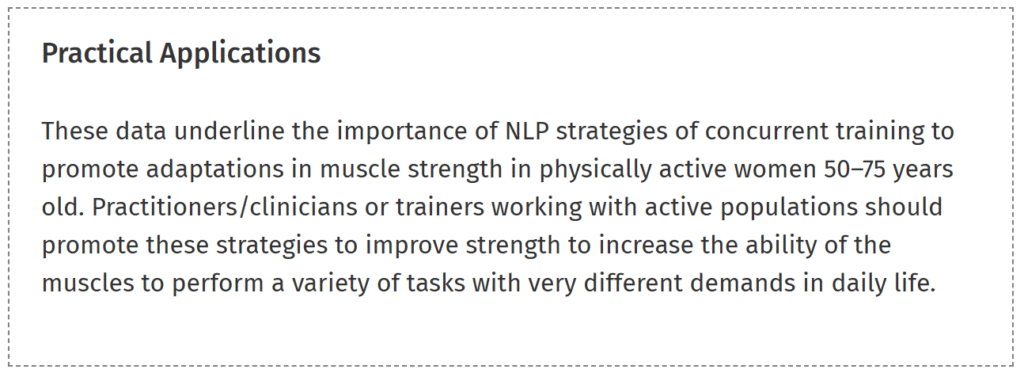
The paradox arises from the discrepancy between the general fitness aspirations of older adults and the rigorous performance demands of younger athletes. Those 50+ frequently experience overtraining within weeks, leading to plateaus, energy depletion, and ultimately withdrawal due to chronic pain or injury.
So, what’s the solution?
- Train all fitness components, but with lots of flexibility around the acute daily training program.
- Semi-strictly periodize two – three exercises per 4wk cycle with a frequency and volume that permits HIGH recovery for all other movements in the program (main goals are indicated in RED below).
- Have a plan ready, but adapt it frequently based on the client or athlete’s readiness ( see articles on resting HR, HRV etc )
- Study & learn the principles of flexible, mixed, non-linear periodization (NLP & FLNP).
The non-linear strategy minimizes the need for full rest days and helps counteract sedentary lifestyles and the “sitting disease,” promoting a sustainable fitness journey for individuals over 50. Below is an example weekly program, integrating all major elements of health and fitness that I use for older adults. While, the Main Strength and Fascial Line movements are progressively overloaded, frequency & variety of movement are prioritized over all else.

In summary, while a mixed periodization model can be effective for older athletes, I advise all older adults pursuing general life, sport, and fitness goals to move away from rigid definitions of periodization. Instead, focus on limited periodization, prioritizing the metabolic / cardio engine, enhancing mobility, preserving joint integrity, encouraging movement variability, and maintaining frequent activity with fewer exhaustive rest days.
References
Bompa, T. O., & Buzzichelli, C. (2015). Periodization: Theory and Methodology of Training. Human Kinetics.
American College of Sports Medicine. (2009). ACSM’s Exercise is Medicine: A Clinician’s Guide to Prescribing Physical Activity. Lippincott Williams & Wilkins. (This resource provides guidance on tailoring exercise prescriptions to various populations, including older adults).
Bird, S. P. (2009). “Strength training and exercise prescription for older adults.” Physical Therapy Reviews, 14(4), 213-220. (This article discusses the physiological benefits and training considerations for older adults, including the importance of variety to prevent overuse injuries).
Faigenbaum, A. D., & Westcott, W. L. (2009). Strength Training for Young Athletes. Human Kinetics. (This book highlights the principles of youth training, which contrast with the needs of older adults, underscoring the need for a different approach later in life).
Owen, N., Healy, G. N., Matthews, C. E., & Dunstan, D. W. (2010). “Too much sitting: the population-health science of sedentary behavior.” Exercise and sport sciences reviews, 38(3), 105-113. (This article provides a comprehensive overview of the health risks associated with a sedentary lifestyle, commonly referred to as “sitting disease.”
Medeiros, Leonardo H.L., Sandbakk, Silvana B., Bertazone, Thaís M.A., Bueno Júnior, Carlos R. (2022). Comparison of Periodization Models of Concurrent Training in Recreationally Active Postmenopausal Women. Journal of Strength and Conditioning Research 36(4):p 977-983, April 20
The Integral Role of Fascia and Muscle Dominant Training Methods in Injury Prevention and Performance Enhancement


In the realm of athletic training and physical rehabilitation, the importance of incorporating methods that target both the fascia and integrated muscle groups cannot be overstated.
Recent studies shed light on the critical need for a complimentary approach to training regimes, highlighting the prevalence and impact of various types of strain injuries. In this meta-analysis of injuries of adults (≥18 years old) engaged in regular athletic sports performance, and diagnosed with lower extremity muscle strain injury with structural tissue damage. From this meta-analysis, results revealed a significant portion of imaging studies revealing a 32.1% prevalence rate for myofascial lesions and 68.4% (see Figure 3. below) for myotendinous lesions, the data underscores the vulnerability of these tissues to strain injuries. Isolated muscular lesions, though less common at 12.7%, present an additional area of concern.
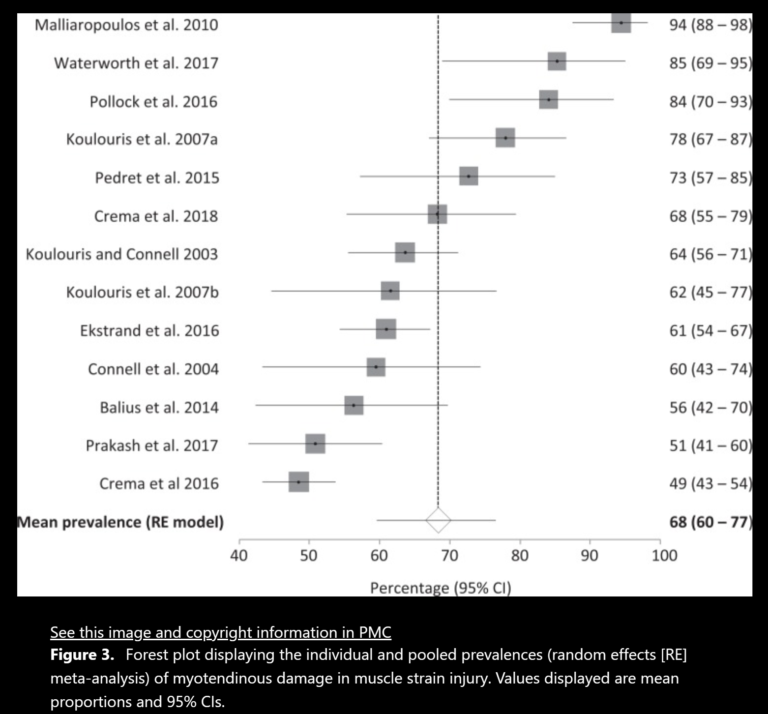
The relationship between fascial health and return to play (RTP) duration presents a complex picture, with evidence suggesting mixed outcomes. However, due to the substantial share of injuries (almost one-third) affecting the epimysium or fascia and its junctions to the muscle, it’s clear end range of strength and elastic recoil are essential to create tendon stiffness.
Takeaway: fascial training is a pivotal factor in both injury prevention and performance enhancement for highly dynamic sports with sudden accelerations, decelerations, and changes of direction. Research indicates that higher tendon stiffness is correlated with decreased electromechanical delay, improved torque development, and enhanced jump performance. This stiffness not only augments force production during dynamic tasks but also acts as a safeguard against the detrimental effects of excessive strain on muscle fibers, maintaining the integrity of the musculoskeletal system even as it adapts to increased physical demands.
This body of evidence highlights the necessity of incorporating training methods that address both fascial and muscular components. By doing so, athletes and individuals engaged in physical rehabilitation can achieve a more balanced and effective training outcome, optimizing performance while minimizing the risk of injury. Training programs that overlook the critical interplay between fascia and muscle risk not only suboptimal performance outcomes but also increased susceptibility to strain injuries. As we continue to unravel the complexities of the human body, the integration of fascia and muscle-dominant training methods stands as a cornerstone of effective physical conditioning and rehabilitation strategies.